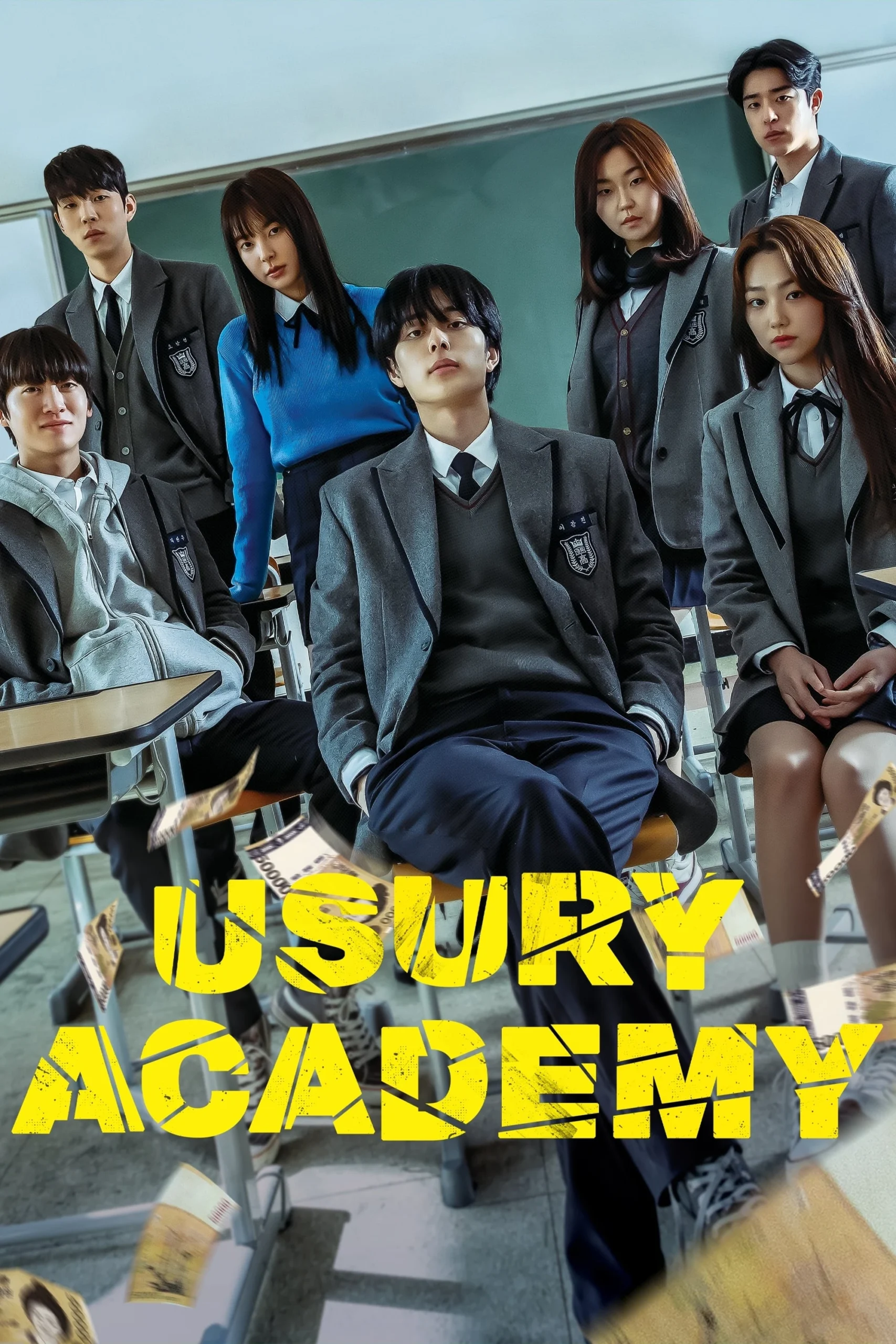
Usury Academy
🎬 Netflix · Viki · Tubi · Apple TV+ · Prime Video · Viu
⭐ 6.8 MDL
🔞 15+
🎬 Film Overview
SCHOOL POWER PICK
Kang-jin has a simple survival strategy: stay small, stay quiet, don’t give Nam-young a reason to notice him. It mostly works, right up until the day he finds an envelope of cash that belongs to Rang, the loan shark whose debt-collection business runs quietly through the neighborhood around his school. Using that money to protect a classmate, Da-young, from a false accusation is meant to be a one-time act of nerve. Instead it puts Kang-jin on Rang’s radar — and Rang, unlike anyone else in Kang-jin’s life, sees potential in him.
What follows is less a revenge story than an apprenticeship. Kang-jin learns the mechanics of debt, leverage, and fear from a genuine expert, and starts running his own lending operation inside the school’s social hierarchy — the same hierarchy that spent years grinding him down. Usury Academy is most interesting in the space between those two facts: every bit of power Kang-jin accumulates is real, and every bit of it is also proof he’s becoming fluent in the exact cruelty that made his life miserable in the first place.
⚡ Quick Verdict
Everything you need to decide, in one place.
· MDL · 703 ratings
▶ Official Trailer
🎭 Cast & Characters
A three-lead core anchored by Yoo Seon-ho, with Kang Mi-na and Yoo In-soo completing the triangle at the center of the school’s new economy.

Lead

Lead

Lead

Supporting

Supporting

Supporting

Supporting

Supporting

Supporting

Supporting

Supporting

Supporting
📖 The Story
Spoiler-free rundown — just enough to gauge if it’s your thing.
Kang-jin’s daily life runs on a simple, exhausting rule: don’t get noticed. Between the debt collectors chasing his family and Nam-young’s casual cruelty at school, he’s spent years perfecting the art of taking up as little space as possible. The film doesn’t rush past this — it lets the grinding, humiliating routine of his life sit long enough that his eventual transformation feels earned rather than sudden.

The break comes almost by accident. An envelope of cash belonging to Rang, a local loan shark, ends up in Kang-jin’s hands, and for the first time in his life he has leverage instead of just debt.
He uses it, at first, for something almost noble — stepping in when Da-young is falsely accused of theft and Nam-young threatens to make an example of her. It’s a small act of defiance with outsized consequences: it puts Kang-jin on Rang’s radar, and Rang, reading real potential in a kid who just outmaneuvered a rich bully with borrowed money, offers to teach him the trade instead of collecting the debt by force.

From there, Usury Academy stops being a bullying story and becomes something closer to an apprenticeship thriller. Kang-jin learns the actual mechanics of predatory lending — how to price fear, how to make debt feel inescapable, how to turn a classmate’s desperation into leverage — and starts running a lending operation inside the same hallway hierarchy that spent years grinding him down.
The film keeps its emotional web tight: Nam-young goes from tormentor to rival now operating on Kang-jin’s terms, Da-young becomes entangled in a triangle none of the three of them asked for, and Rang occupies a strange, unstable space between mentor and cautionary tale. None of these relationships stay simple for long, because everyone in Kang-jin’s orbit is now also, in some sense, a client, a competitor, or a debt.
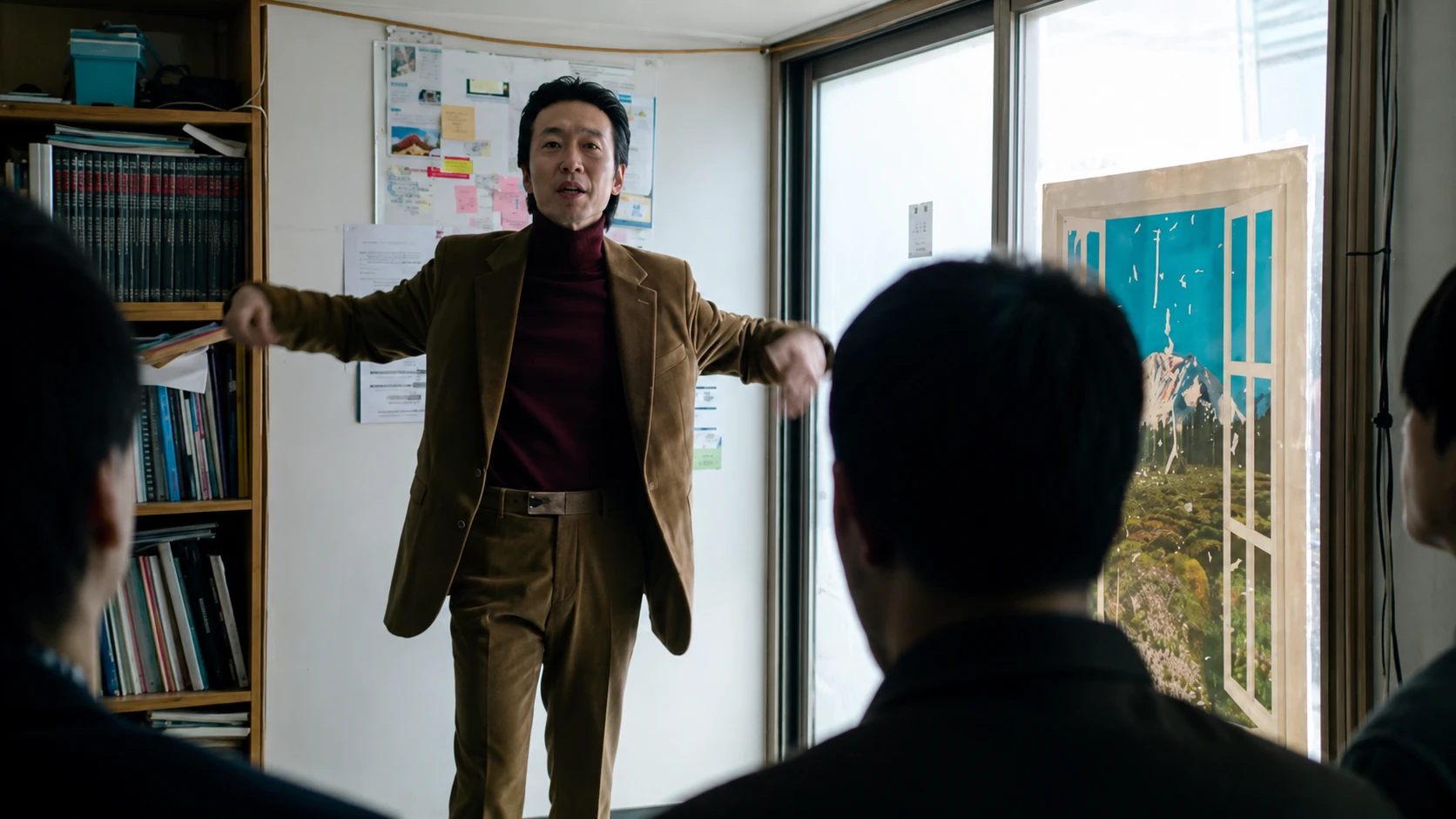
What makes the premise work is how literally it treats the metaphor — this isn’t a film about bullying that uses financial language as flavor, it’s a film that actually runs a school’s social order through the logic of interest rates, collateral, and collection deadlines. Confrontations that would read as ordinary schoolyard drama in another film instead play out like business disputes with teenage stakes attached.
That specificity is also the point. Usury Academy is tapping into a real and uncomfortable trend in Korea — predatory private lending creeping into younger and younger demographics — and using a high school setting to make that anxiety concrete instead of abstract. Kang-jin’s rise isn’t just a personal arc; it’s a small-scale demonstration of how easily a predatory system reproduces itself in whoever learns to run it.

🏁 Ending Explained
The ending, explained in full. Spoilers ahead.
Full Spoilers Ahead — This section covers the complete ending of Usury Academy. Stop here if you haven’t watched.
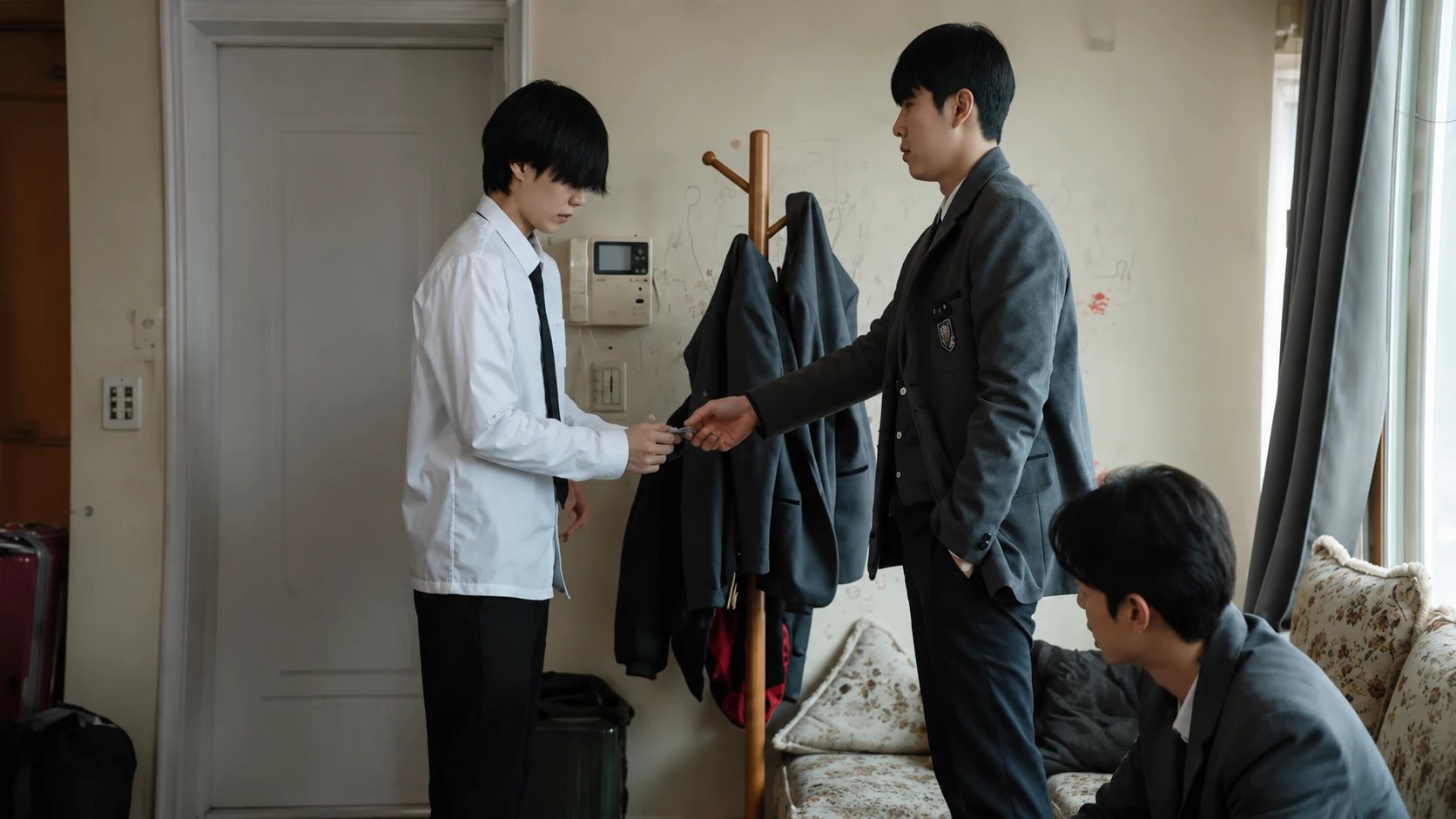
What actually happens Kang-jin’s endgame is a trap, not a fight. After Man-soo gets beaten by Nam-young’s crew, Kang-jin hands him Rang’s business card, knowing exactly what that will set in motion. Rang and his men storm the karaoke bar where the beating happened, tear through Nam-young’s gang, and force Nam-young to sign a debt contract making him personally responsible for the money he stole from Kang-jin — at 10 percent interest a week.

A second reckoning, in parallel While that’s playing out, Da-young has her own confession to make. She’s been stealing from wealthy men to survive, and she admits it to Kang-jin before deciding to turn herself in — along with recordings that expose Detective Choi’s corruption. Choi orders Rang to silence her before she can talk. Her decision to come forward gets there first.
The fallout at school The two threads collide back at school. Shin-ji, still raw from Nam-young rejecting her, spreads a photo to humiliate him publicly, then turns on Da-young, threatening to expose her fraud case. Da-young doesn’t flinch — she’s already decided to surrender. What breaks Shin-ji isn’t the threat landing wrong; it’s Nam-young stepping in to defend Da-young anyway, right in front of her. Feeling discarded by the one person she’d stayed loyal to through everything, Shin-ji jumps from the school roof.

What it means That death, not Kang-jin’s debt contract or Da-young’s confession, is the film’s real ending. Usury Academy frames it as the direct cost of the loan-shark economy Kang-jin built — a system that turned every relationship in the school into leverage, until the one person left with nothing to leverage was the one who got hurt worst.
The KDW verdict On rewatch, the business card Kang-jin hands Man-soo stops looking like a lucky break and starts looking like a calculated move — proof he’d fully absorbed Rang’s lessons rather than just survived them. The film’s thesis lands hardest here: once you learn to run people through a debt economy, you don’t get to opt back out selectively. The same machinery that punishes Nam-young is what leaves Shin-ji with nowhere to land. Kang-jin wins his rematch. Nobody else really does.
✍️ KDramaWorlds Editor’s Take
Our honest opinion — and the kind of viewer who’ll love it most.
Hwang Dong-Seok
Known for: Hwang Dong-seok both wrote and directed Usury Academy, building its premise around a straightforward but rarely used idea: staging predatory lending literally inside a Korean high school rather than using the setting as backdrop. His approach favors momentum and social specificity over slow character study, and the film reflects that — a brisk, hard-edged genre piece more focused on how a predatory system reproduces itself than on spending time inside any single character’s interiority.
Yoo Seon-ho plays Kang-jin’s transformation with real physical precision — the hunched, don’t-look-at-me posture of the opening scenes gradually straightens out, scene by scene, into something colder and more deliberate. It’s a performance built on body language more than dialogue, and it’s the main reason the film’s back half works even when the plotting gets thin. That commitment to watching a character’s morality erode in real time recalls Devils, another Korean crime thriller more interested in a mind changing than a plot twisting.

The film’s smartest structural choice is treating loan-sharking not as an underworld Kang-jin descends into, but as a literal, functioning economy operating in plain sight inside a school building — a choice that gives every scene a grounded, almost bureaucratic menace instead of stylized crime-movie theatrics. Viewers who liked how Ordinary Person made systemic corruption feel procedural rather than cartoonish will recognize the same instinct here, just scaled down to teenage stakes.
The ending is also where the film’s biggest criticism in Korea comes from — not that it pulls punches, but that it doesn’t earn the one it throws. Shin-ji’s death lands as the story’s most drastic consequence, and several Korean reviewers have called it abrupt and under-motivated relative to everything that built up to it — a single scene asked to carry weight the script hadn’t fully set up for her specifically. It’s a fair critique. Usury Academy is sharper as a system-level portrait of how debt corrupts a school than as a character study of the one person it actually destroys.
🎬 You Might Also Like
If you liked Usury Academy, these are your next three watches.
 Welcome to Waikiki (Season 1)
comedyFound Family
Read Full Review →
|
 The Light in Your Eyes
Alzheimer'sfamily
Read Full Review →
|
 Something in the Rain
Age GapJung Hae-in
Read Full Review →
|
















Keep it kind, skip the harsh language, and please — no spoilers. Everyone's taste is different, and that's perfectly fine.
This space is for real reactions and discussion from other viewers. Help keep it comfortable for everyone by not giving away major plot details.
1 Comment
Kang-jin’s entire survival strategy being “don’t get noticed” is such a tight baseline, and one act of nerve to protect a classmate being the thing that finally gets him noticed by exactly the wrong person is a great inciting incident 💰 — Rang seeing potential in him instead of just using him is what makes the loan shark’s interest genuinely unsettling rather than simple. Curious how everyone felt about how far Kang-jin actually got pulled in.
What do you think of this drama?
Login to share your review or leave a comment.
No email needed — just pick a username & password.